Matryoshka World


Showing posts with label MWI. Show all posts

Tuesday, August 4, 2015

Theories of Everything, Mapped

Quanta Magazine provides a neat, interactive guide to Theories of Everything:

TOE, an interactive guide


Friday, July 26, 2013

Frank Wilczek's paper on the prsopect of a multiverse: "Multiversality"


Valid ideas that physical reality is vastly larger than human perception of it, and that the perceived part may not be representative of the whole, exist on many levels and have a long history. After a brief general inventory of those ideas and their implications, I consider the cosmological “multiverse” much discussed in recent scientific literature. I review its theoretical and (broadly) empirical motivations, and its disruptive implications for the traditional program of fundamental physics. I discuss the inflationary axion cosmology, which provides an example where firmly rooted, plausible ideas from microphysics lead to a well-characterized “mini-multiverse” scenario, with testable phenomenological consequences

Friday, March 8, 2013

How does the Anthropic Principle change the meaning of the universe?


 Are the finely-tuned physical laws that surround us mere coincidence, or does it imply that we are somehow meant to be here? That's where the Anthropic Principle comes into play.
How does the Anthropic Principle change the meaning of the universe?

Monday, June 4, 2012

Scientific American: The Case for Parallel Universes

The Case for Parallel Universes

 "Multiverse proponents Alexander Vilenkin and Max Tegmark offer counterpoints [to previous criticisms of multiverse theory], explaining why the multiverse would account for so many features of our universe—and how it might be tested."


Friday, April 20, 2012

The Multiverse Interpretation of Quantum Mechanics

Raphael Bousso and Leonard Susskind argue that the many-worlds of quantum mechanics and the many worlds of the multiverse are the same thing.
We argue that the global multiverse is a representation of the many-worlds (all possible decoherent causal diamond histories) in a single geometry. We propose that it must be possible in principle to verify quantum-mechanical predictionsexactly. This requires not only the existence of exact observables but two additional postulates: a single observer within the universe can access in nitely many identical experiments; and the outcome of each experiment must be completely de nite. In causal diamonds with nite surface area, holographic entropy bounds imply that no exact observables exist, and both postulates fail: experiments cannot be repeated in- nitely many times; and decoherence is not completely irreversible, so outcomes are not de nite. We argue that our postulates can be satis ed in \hats" (supersymmetric multiverse regions with vanishing cosmological constant). We propose a complementarity principle that relates the approximate observables associated with nite causal diamonds to exact observables in the hat.
 The Multiverse Interpretation of Quantum Mechanics

Monday, March 12, 2012

Questions no one knows the answers to

In a new TED-Ed series designed to catalyze curiosity, TED Curator Chris Anderson shares his obsession with questions that no one (yet) knows the answers to. This introduction leads into two questions as follow-up films: Why can't we see evidence of alien life? on.ted.com/AlienLife and How many universes are there? on.ted.com/HowMany ... Find more TED-Ed videos on our new YouTube channel: youtube.com/TEDEd.


Sunday, February 13, 2011

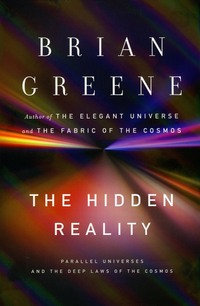
Brian Greene: The Hidden Reality: interview and excerpt from his new book


Brian Greene's new book The Hidden Reality: Parallel Universes and the Deep Laws of the Cosmos, explores how the cutting edge theories of physics including string theory, inflation, and quantum mechanics suggests that our universe may be one of many.

NPR recently had a story on Greene's new book that included an excerpt of the first chapter. Here is the link.

The Wall Street Journal recently interviewed Greene about his new book. Link to WSJ article.

Friday, August 27, 2010

Infinite doppelgängers may explain quantum probabilities

AN IDENTICAL copy of you is also reading this story. This twin is the same in every way, living on an Earth and in a universe that looks exactly like our own. And there may be an infinite number of them. Such doppelgängers could be a natural consequence of our present conception of the universe. Now, some physicists say they could pose a serious problem for quantum mechanics. But a possible fix may also be in sight, and it could help tie abstract quantum concepts to concrete physical causes.


New Scientist article based on this paper.

Wednesday, January 13, 2010

Computational capabilities of physical systems

By David Wolpert: "In this paper strong limits on the accuracy of real-world physical computation are established."

Link

Monday, November 9, 2009

The Many Worlds FAQ page


Frequently asked questions regarding the Many Worlds Theory of Quantum Mechanics

Wednesday, May 13, 2009

Tegmark's Parallel Universes article


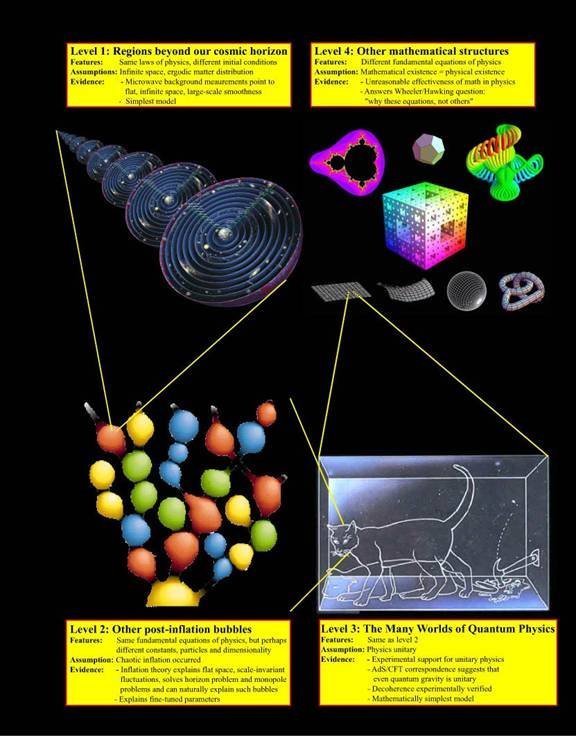
This article on parallel universes is linked on a few sites I have previously listed, however I believe it is worthy of a direct link. Tegmark provides a good, uncomplicated overview of the different types, or levels, of possible parallel universes. Some or all of them may actually exist.

The first three levels of parallel universe are completely distinct from our universe, and get progressively strange (for lack of a better description) comparison to the universe we are in. For instance, level one is essentially just regions of our present universe that are beyond our light horizon. It is estimated that the region of our universe we can actually see is only a very small portion of the whole, however the actual size and shape of our universe is not established. Level two parallel universes represent other post-inflation bubbles; in other words other universes that may have resulted from the big bang and subsequent inflation. In these universes the fundamental physics would be the same but the constants would be different. Finally, the level three universes would have different fundamental physics.

Level four universes can be considered somewhat distinct from the first three, in that if the parallel universes of quantum mechanics exist they overlap and interact in a way the other levels do not. These universes would all share the laws of quantum mechanics.

Friday, October 31, 2008

Parallel Worlds, Parallel Lives


"Parallel Worlds, Parallel Lives is a BAFTA winning television documentary broadcast in 2007 on BBC Scotland and BBC Four television documentary in which American rock musician Mark Oliver Everett talks to physicists and the former colleagues of his father—Hugh Everett— about his father's many-worlds interpretation of quantum mechanics."

Parallel Worlds, Parallel Lives

Tuesday, June 24, 2008

Mangled Worlds Quantum Mechanics

"This variation on the many worlds interpretation of quantum mechanics allows us to derive the Born probability rule via finite world counting and no new physics."

When Worlds Collide

Friday, May 23, 2008

Many lives in many worlds


Article by Max Tegmark in July, 2007 Nature on Many Worlds theory (as posted on 12 Degrees of Freedom).

Wednesday, May 14, 2008

Plausibility of the Existence of all Possible States


http://www.physica.freeserve.co.uk/pa01.htm
The argument for the existence of all possible worlds has in the past been deemed problematical due to the failure of induction it implies. In this paper I argue that by focussing on an approach that distinguishes a hidden reality from the world of appearance, and on a corresponding generalisation from 'all possible worlds' to 'all possible states', this problem is readily surmountable. Moreover the positive success of inductive reasoning and the lack of observed paranormal events emerge as a natural consequence.

--ALASTAIR MALCOLM

Friday, September 28, 2007

New Scientist article on new work by Deutsch

Parallel universes make quantum sense

19 September 2007 NewScientist.com

by Zeeya Merali -- If you think of yourself as unique, think again.
The days when physicists could ignore the concept of parallel
universes may have come to an end. If that doesn't send a shudder down
your spine, think of it this way: our world is just one of many. You
are just one version of many.

David Deutsch at the University of Oxford and colleagues have shown
that key equations of quantum mechanics arise from the mathematics of
parallel universes. "This work will go down as one of the most
important developments in the history of science," says Andy Albrecht,
a physicist at the University of California at Davis. In one parallel
universe, at least, it will - whether it does in our one remains to be
seen.

The "many worlds" interpretation of quantum mechanics was proposed 50
years ago by Hugh Everett, a graduate student at Princeton University.
Rather than apply one set of rules to the subatomic quantum world and
another to the larger-scale everyday world, as physicists tend to do,
Everett wanted to apply quantum mechanical equations to everything.
This had some startling consequences.

According to quantum mechanics, particles do not have set properties
before they are observed. Instead, particles are described by "wave
functions" representing many mutually contradictory properties. It is
only when an observer measures a property that the particle somehow
settles into one of these multiple options. The paradox is exemplified
by Schrodinger's cat - the famous thought experiment in which a cat in
a box can be said to be both alive and dead. It is traditionally
thought that the act of observation, opening the box to check the cat,
is what forces it to settle into a state, living or dead.

If, as Everett argued, quantum mechanics is applied to the whole
universe, then it too should exist in a multitude of separate states.
There would be a "multiverse" of parallel universes - one for every
physical possibility. So when you open the box holding Schrodinger's
cat, the universe splits, forming two new "yous" - one whose future
involves viewing the live cat and the other who sees the dead cat.

Dismissed by the scientific establishment as ridiculous for decades,
the many-worlds scenario may at last come in from the cold thanks to
Deutsch's work.

The biggest criticism leveled at many worlds was that it seemed to
make a puzzle about the outcomes of quantum experiments even worse.
Physicists can predict the probability of getting a certain outcome
from a quantum experiment from the square of its wave function,
according to the Born rule. Nobody can explain why this rule works, it
simply fits with experimental observations. The problem was there
seemed to be no place for the Born rule in the multiverse. In fact,
there didn't seem to be any space for any probabilities at all, says
Deutsch.
"You toss a coin, but what does it mean to say that the probability of
it coming up heads is 50 per cent?" Deutsch asks. "According to
Everett, both outcomes must happen."

In the mid-1990s, Deutsch set out to put the uncertainty we see in
quantum mechanical experiments back into the many-worlds scenario.
Now, with additional work by Simon Saunders and David Wallace, also at
Oxford, he believes they have succeeded. The trick is to examine a
quantum experiment while excluding probability theory and accepting
the many-worlds interpretation.

The multiverse has a branching structure, created as the universe
splits into parallel versions of itself. The thickness of the branches
can be calculated solely using deterministic equations, getting around
the uncertainties usually associated with quantum physics. What the
Oxford gang found is that the branching structure exactly reproduces
the peculiar probabilities predicted by the Born rule. The branching
also gives the illusion of probabilistic outcomes to measurements.

Deutsch believes this solves the problem of the origin of quantum
probability once and for all. "Probabilities used to be regarded as
the biggest problem for Everett, but ironically, they are now its most
powerful success," he says.

"We've cleared up the obscurities and come up with a pretty clear
verdict that Everett works," says Saunders, who is presenting the work
with Wallace at the Many Worlds at 50 conference at the Perimeter
Institute for Theoretical Physics in Waterloo, Canada, this week.
"It's a dramatic turnaround and it means that people now have to
discuss Everett seriously."

Albrecht agrees that the work will shake up physicists' worlds. "Many
people are uncomfortable about the probabilities at the heart of
quantum mechanics and attempt to get rid of quantum mechanics because
of it," he says. "But this greatly amplifies the fundamental place of
quantum mechanics in our understanding of the physical world."

David Papineau, a philosopher of physics at King's College London,
says that he has been converted from scepticism about many worlds to
belief, based on its potential to one day solve this puzzle of quantum
probabilities. He adds, though, that the work by Deutsch, Wallace and
Saunders must now be scrutinised. "It's an ambitious claim and so we
have to be careful," he says. For Papineau, the problem is whether a
belief in parallel universes should affect the way we live our
everyday lives .

Max Tegmark at the Massachusetts Institute of Technology has long been
a fan of the many-worlds scenario. But while he believes the new work
on probability should help convince physicists of its reality, it will
never be enough to win over die-hard sceptics. "The critique of many
worlds is shifting from 'it makes no sense and I hate it' to simply 'I
hate it'," he says.

David Albert, a philosopher of physics at Columbia University, New
York, is sceptical. He argues there is good reason to be wary because
the Oxford group may be guilty of sleight of hand. "When you first
hear about this you feel euphoric," he says. "But then you think,
maybe this is too good to be true." He believes that it is irrelevant
that Deutsch and his colleagues can show that branching universes give
the illusion of probabilistic outcomes to measurements. What we really
want to know, says Albert, is why this branching happens in the first
place. "They have answered a question, but I think it's the wrong
question," he says.

Wojciech Zurek at the Los Alamos National Laboratory in New Mexico
believes that the Born rule is exactly the right question to tackle.
However, he believes that it can be answered without resorting to
parallel universes. Zurek points out that Everett never used the term
"many worlds" in his papers, and says that his work can be interpreted
in less controversial ways.

Zurek is also inspired by Everett's ideas, particularly his insight
that quantum mechanics must be applied to the entire universe rather
than a limited quantum realm. He interprets this to mean that quantum
entanglement - the process in which quantum particles can become
inextricably linked and act in unison no matter how far apart they are
- is a fundamental ingredient of quantum physics. Zurek has already
used this property to explain why we see a single objective reality
when we make a measurement of a quantum state (New Scientist, 30 June,
p 18). Zurek says that entanglement can also be used to derive the
Born rule (www.arxiv.org/abs/0707.2832). "I could not have derived
probability without using Everett," says Zurek, who is also presenting
his work at the conference. "But at no point am I forced to assign
equal reality to all other versions of the universe in the many-worlds
scenario."

For Tegmark, the fact that many worlds is sparking such debate, 50
years after its conception, is a triumph in itself. He believes that
physicists interested in quantum computing and cosmology are now
warming to it. Will the majority be won over? "That depends on what
parallel universe you live in," he says.

>From issue 2622 of New Scientist magazine, 19 September 2007, page 6-7

[Just another universe]

Like Schrodinger's cat, you're locked in a box with a vial of poison
gas. If a radioactive atom decays before someone opens the box to
observe you, the gas will be released. According to the multiverse
picture, in one future "you" will live, because the atom has not
decayed, and in another "you" will die. So, should you be worried?

The issue of how we should feel and act when faced with a constantly
splitting identity will be addressed by David Papineau of King's
College London at a conference on the many-worlds scenario in
Waterloo, Canada this week.

To start with, Papineau considers feelings of guilt and hope in the
multiverse. Suppose that you are driving recklessly and narrowly avoid
crashing into another car. "You might think 'lucky escape', but you
should be feeling guilty about the passengers your other self has
killed," says Papineau.

He also questions the use of hope. "You hope your football team will
win a match, but that's meaningless - they both win and lose," he says.
Although each of our descendant selves is equally real, thankfully
Papineau argues that their fates shouldn't affect our choices before
we make them. We should be just as reluctant, or excited, about
climbing into Schr?dinger's box in the many-worlds picture, as we
would be if we believed that only one outcome is actually realised.

Simon Saunders at the University of Oxford doesn't think that Papineau
is wrong, but does think he is asking too much of us. "The multiverse
will drive you crazy if you really think about how it affects your
life, and I can't live like that," he says. His solution? "I'll just
accept Everett and then think about something else, to save my
sanity."