Matryoshka World


Showing posts with label Megascale engineering. Show all posts

Friday, October 16, 2015

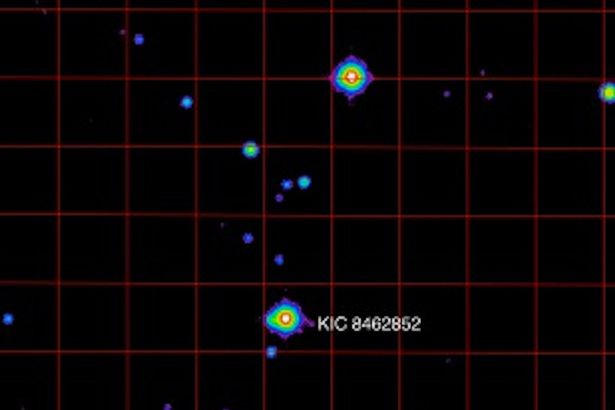
Star KIC 8462852 and Alien Megastructures


After the Atlantic posted this article earlier this week, there was a resulting media frenzy regarding the possibility that the Kelper space telescope had detected evidence of an intelligent alien mega-engineering project.  

It is important to keep in mind that no scientist who has been involved in the study of this star to date is arguing or theorizing that alien engineering is the most likely explanation for the observed anomalies around KIC 8462852, but rather it has been noted that no known natural explanation provides a good fit for observation, and in some aspects the observations match what was predicted if Kepler did happen to stumble across a system with megastructures.   

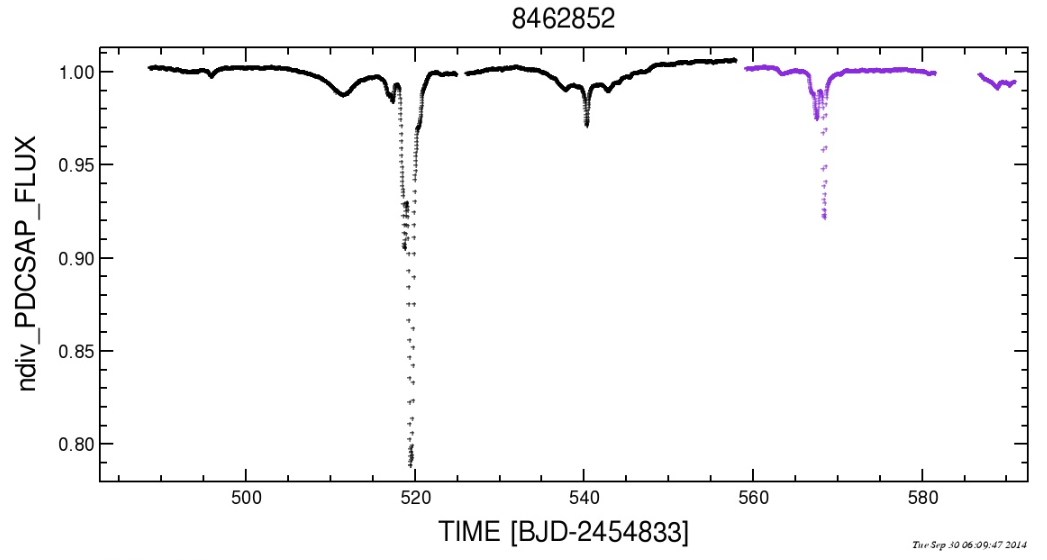
What makes KIC 8462852 so unusual is a combination of the type of star that it is, and the observed bizarre changes in brightness of the star. The Kepler telescope looks for tiny dips in starlight to detect exoplanets.  Even very large gas giant exoplanets would only cause a dip in brightness of a star this size by 1 percent or less.  However, the observations from this star included dips in light far greater than any planet could create, and the dips were not symmetric or periodic as would be expected with planets.  In particular, two dips in brightness were far outside the range of any normal phenomena.   The first major dip obscured the star's brightness by up to 15%, and the other by up to 22%. Dips of this size would indicate a transit of something covering up to half the width of the star.

 One possibility would be a disk circumstellar dust, or rings.  However, the star is not a young star by all observations, making this type of a possibility unlikely.  Other theories invoke a recent planetary collision, however these events are incredibly rare and it is highly unlikely this would provide an answer.  In addition, a massive collision scenario would create dust that glows in infrared wavelengths, but there is no observed excess infrared energy, ruling out massive planetary collision debris or other explanations that invoke large dust or debris clouds.

Whatever the explanation for the strange observations so far of KIC 8462852, it is likely to involve a new and interesting to date undiscovered phenomena.  It seems likely that if we do discover proof of alien intelligence it will be through a gradual understanding of observations and interpretation of evidence over time.  Because such an extraordinary claim requires extraordinary proof, essentially to the point of almost completely excluding natural explanations, a sudden discovery is unlikely. Rather, such a finding will require the long, difficult process of excluding all other possible explanations (as it should). Whether it ends up being this observation or something else, we will likely only gradually come to fully understand over time what the importance of a discovery as earth shattering as alien intelligent life if this type of discovery is ever made.  Here are some links of interest regarding KIC 8462852:


Friday, February 15, 2013

Why we will never build a space elevator

I do not agree with this assessment which I believe to be overly pessimistic.  However there is not doubt the technological hurdles are very real, and it will probably be several decades before such a project becomes at all feasible under even a best case scenario. 

Much more promising is the prospect for a space elevator on the moon.  This paper discusses the possibility of and potential design of a lunar elevator.

Friday, May 25, 2012

Monday, January 17, 2011

The Physics of Information Processing Superobjects: Daily Life Among the Jupiter Brains


"In this review, I discuss physical limitations on density, speed, size, energy dissipation and communication, sketching the constraints on very powerful information processing objects."

Daily Life Among the Jupiter Brains

Sunday, January 16, 2011

Galactic gradients, postbiological evolution and the apparent failure of SETI

Here is the abstract of this very interesting paper by Robert Bradbury:


Motivated by recent developments impacting our view of Fermi’s Paradox (the absence of extraterrestrials and their manifestations from our past light cone), we suggest a reassessment of the problem itself, as well as of strategies employed by the various SETI projects so far. The need for such reassessment is fueled not only by the failure of SETI thus far, but also by great advances recently made in astrophysics, astrobiology, computer science and future studies. As a result, we consider the effects of the observed metallicity and temperature gradients in the Milky Way galaxy on the spatial distribution of hypothetical advanced extraterrestrial intelligent communities. While properties of such communities and their sociological and technological preferences are, obviously, unknown at present, we assume that (1) they operate in agreement with the known laws of physics and (2) at some point in their history they typically become motivated by a meta-principle embodying the central role of information-processing; a prototype of the latter is the recently suggested Intelligence Principle of Steven J. Dick. There are specific conclusions of practical interest to astrobiological and SETI endeavors to be drawn from the coupling of these reasonable assumptions with the astrophysical and astrochemical structure of the spiral disk of our galaxy. In particular, we suggest that the outer regions of the Galactic disk are the most likely locations for advanced SETI targets, and that sophisticated intelligent communities will tend to migrate outward through the Galaxy as their capacities of information-processing increase, for both thermodynamical and astrochemical reasons. However, the outward movement is limited by the decrease in matter density in the outer Milky Way. This can also be regarded as a possible generalization of the galactic habitable zone (GHZ), concept currently being investigated in astrobiology.
Keywords: Astrobiology; Galaxy: evolution; Extraterrestrial intelligence; Physics of computation; SETI