Matryoshka World


Thursday, May 31, 2012

Scientific American: How a plan for a faster than light communication device led to a breakthrough in understanding quantum mechanics

Scientific American has an interesting blog post on Nick Herbert's attempt to create a faster than light communication device several decades ago that led to the discovery of the "no-cloning theorem": which states an arbitrary or unknown quantum state cannot be copied without disturbing the original state. 

The Faster-Than-Light Telegraph That Wasn't


Friday, May 25, 2012

Monday, May 21, 2012

Brian Greene: Welcome to the Multiverse

Brian Greene has an article in Newsweek about the possibility of a multiverse.

   Welcome to the Multiverse


Friday, April 20, 2012

The Multiverse Interpretation of Quantum Mechanics

Raphael Bousso and Leonard Susskind argue that the many-worlds of quantum mechanics and the many worlds of the multiverse are the same thing.
We argue that the global multiverse is a representation of the many-worlds (all possible decoherent causal diamond histories) in a single geometry. We propose that it must be possible in principle to verify quantum-mechanical predictionsexactly. This requires not only the existence of exact observables but two additional postulates: a single observer within the universe can access in nitely many identical experiments; and the outcome of each experiment must be completely de nite. In causal diamonds with nite surface area, holographic entropy bounds imply that no exact observables exist, and both postulates fail: experiments cannot be repeated in- nitely many times; and decoherence is not completely irreversible, so outcomes are not de nite. We argue that our postulates can be satis ed in \hats" (supersymmetric multiverse regions with vanishing cosmological constant). We propose a complementarity principle that relates the approximate observables associated with nite causal diamonds to exact observables in the hat.
 The Multiverse Interpretation of Quantum Mechanics

Thursday, April 19, 2012

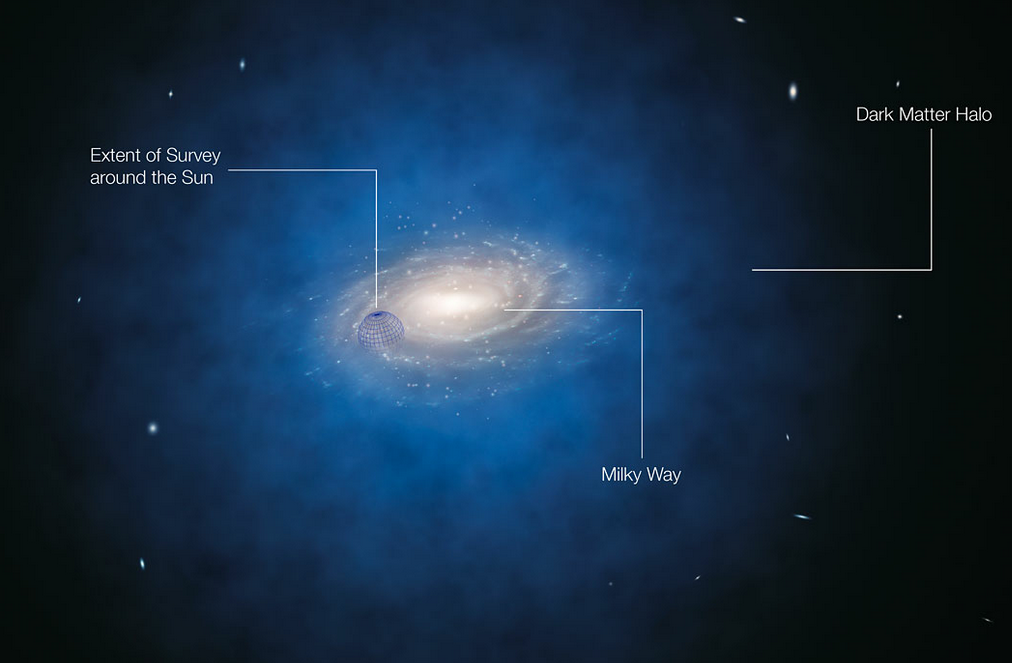
Lack of evidence of dark matter in solar neighborhood may indicate dark matter theories are wrong


A new study of the motions of stars in the Milky Way has found no evidence for dark matter in a large volume around the Sun.

This is kurzweilai.net's article on the findings:

Serious Blow to Dark Matter Theories?

Tuesday, April 17, 2012

Monday, April 16, 2012

A disappearing physicist, and a discovery that may lead to understanding dark matter and a real quantum computer

Kurzweilai.net has an article on the possible recent discovery of “Majorana fermions” — particles that "would be right on the border between matter and antimatter."

Some theories even suggest that these particles may ultimately provide the explanation for Dark Matter. Also, the article suggests that "Majorana fermions could be fundamental building blocks for a future quantum computer that would be exceptionally stable and barely sensitive to external influences. This would avoid the central problem with all current quantum computers: the dreaded decoherence."

The Kurzweilai.net article is based on this paper published last week in Science Express.

This video summarizes the experiment leading to the discovery:


Friday, April 13, 2012

Artificial Intelligence Could Be on Brink of Passing Turing Test


Wired.com has a post summarizing an article in Science which suggests recent advances in information technology could have us on the brink of strong AI capable of passing a Turing test. This means that if you had a conversation with the computer program you would not be able to distinguish whether you were talking to a program or real person. Kurzweil has predicted the first AI capable of passing the Turing test sometime in the latter part of the next decade.

“Two revolutionary advances in information technology may bring the Turing test out of retirement,” wrote Robert French, a cognitive scientist at the French National Center for Scientific Research, in an Apr. 12 Science essay. “The first is the ready availability of vast amounts of raw data — from video feeds to complete sound environments, and from casual conversations to technical documents on every conceivable subject. The second is the advent of sophisticated techniques for collecting, organizing, and processing this rich collection of data.”


Monday, March 12, 2012

Questions no one knows the answers to

In a new TED-Ed series designed to catalyze curiosity, TED Curator Chris Anderson shares his obsession with questions that no one (yet) knows the answers to. This introduction leads into two questions as follow-up films: Why can't we see evidence of alien life? on.ted.com/AlienLife and How many universes are there? on.ted.com/HowMany ... Find more TED-Ed videos on our new YouTube channel: youtube.com/TEDEd.


Thursday, February 9, 2012

The Technium: Next Transitions

As a follow on to the recent post about future filters civilization may have to survive, the Technium provides this post that considers possible transitions civilization may go through in the foreseeable future:


Next Transitions in the Technium

"What kinds of developmental thresholds would any planet of sentient beings pass through? The creation of writing would be a huge one. The unleashing of cheap non-biological energy is another. The invention of the scientific method is a giant leap. And the fine control of energy (as in electricity) for long-distant communications is significant as well, enabling all kinds of other achievements. Our civilization has passed through all these stages; what are some future transitions we can expect -- no matter the fashions and fads of the day? What are the emergent thresholds of information and energy organization that our civilization can look forward to? Most of these thresholds are gradual, so we can't assign dates, but each of these structures seem to be a natural transition that any civilization must reach sooner or later."